Sensitive Plant
| Polish version is here |
The following article was originally published in the journal for educators Biologia w Szkole (eng. Biology in School) (6/2015):

Animals and plants - are they really all that different?
There’s no question that plants play a vital role in sustaining life on Earth. In fact, photosynthetic organisms, including plants, form the very foundation of life as we know it. Think about it for a moment: where does all the energy used by living things actually come from? Physics tells us that energy cannot simply appear out of nowhere or disappear without a trace; it can only change from one form to another. When you think about it, it becomes clear that nearly all the energy used by living organisms originates from the Sun, our life-giving star. The only exceptions are a few primitive chemotrophic bacteria that obtain energy by oxidizing certain inorganic compounds or methane [1]. All the energy that sustains humans, animals, and most other life forms was once produced inside the Sun through nuclear reactions. It traveled to Earth as electromagnetic radiation of various wavelengths and was later captured and converted by plants into chemical energy. Only in this form does it become usable for most organisms other than plants. In recent years, scientists have discovered a few remarkable exceptions to this rule. One of them is the sea slug Elysia chlorotica, which can, for part of its life, live photoautotrophically by using chloroplasts obtained from algae to carry out photosynthesis [2].
For the most part, animals lack any mechanism that allows them to capture energy directly from sunlight. It is therefore quite surprising that, in popular opinion, plants are often viewed as simpler or more primitive organisms than animals. In my view, this misconception arises from a limited understanding of the very different evolutionary strategies that animals and plants have developed.
There are, without a doubt, many differences between animals and plants. They differ in metabolism, in the structure of their cells, tissues, and organs, as well as in the ways they interact with other organisms and with their environment. Despite these differences, both groups share fundamental biological principles that reflect their common evolutionary origins.
One of the most striking differences is the ability of animals to move, a feature that plants appear to lack. Yet that is not entirely true. While it is correct that, unlike most animals, plants cannot move from place to place on their own, they are still capable of movement. The mechanisms behind plant movement differ greatly from those in animals, which rely mainly on specialized proteins such as myosin. In plants, movement occurs primarily through growth and changes in turgor pressure. Growth movements result from cell expansion and division, while turgor movements are caused by shifts in internal pressure that change the volume of plant cells.
Depending on the mechanism involved, plant movements can be divided into three main types:
- tropisms,
- taxis,
- nastic movements.
Tropisms are growth responses in plants that occur in reaction to a directional stimulus. They result from an uneven distribution of plant hormones, known as auxins, within tissues or organs. This uneven distribution causes cells in different regions of the organ to grow at different rates, leading the structure to bend toward or away from the stimulus. A tropism is considered positive when the organ grows toward the source of the stimulus, and negative when it grows in the opposite direction. Depending on the nature of the stimulus, we can identify several types of tropisms, including phototropism, geotropism, hydrotropism, and thermotropism.
Movements of entire small organisms, such as ciliates, that occur in response to a directional stimulus are called taxis. Movement toward the stimulus is known as positive taxis, while movement in the opposite direction is called negative taxis. These movements help organisms find the most favorable environmental conditions for survival.
Nastic movements are bending responses that do not depend on the direction of the stimulus. They can also be triggered by diffuse or non-directional stimuli. Nasties differ fundamentally from tropisms because, unlike tropic movements, they are primarily caused by changes in the turgor pressure of specific cells.
Turgor is the state of tension in a plant cell wall caused by the hydrostatic pressure of the fluid inside the cell. This pressure keeps plant tissues firm and helps maintain the shape of both individual cells and entire plant organs.
Depending on the type of stimulus, plant movements can be divided into:
- chemonasty — a response to chemical stimuli,
- thermonasty — a response to changes in ambient temperature,
- seismonasty — a response to mechanical, thermal, or electrical stimuli,
- photonasty — a response to changes in light intensity [3].
In addition to these types of plant movement, other forms also occur, such as hygroscopic movements. These arise from uneven drying or absorption of water by dead cell wall fibers and membranes.
We can therefore say with complete confidence that it is not true that plants do not move. Why, then, is the common belief otherwise? The answer seems simple: plant movements are usually very slow, with speeds much lower than those observed in animals. Most importantly, movement at such a pace is imperceptible to the naked eye. To observe plant motion, one must rely on clever and often time-consuming methods such as time-lapse photography taken at long intervals, sometimes over the course of several weeks.
However, there are some plants whose movements can be seen without any instruments or technical assistance. A good example is the Venus flytrap (Dionaea muscipula), a carnivorous plant whose trap-like leaves close on prey, such as an insect, within just a few seconds.
Growing Venus flytraps and other carnivorous plants can be somewhat challenging, especially in a classroom setting. It is certainly a rewarding experience, but this time I would like to introduce the reader to another fascinating plant that I can wholeheartedly recommend to anyone interested. I am referring to the sensitive plant (Mimosa pudica), also known as the touch-me-not, which displays remarkably clear seismonastic movements.
Cultivation and Observation
The sensitive plant (Mimosa pudica) belongs to the legume family (Fabaceae) and the subfamily Mimosoideae. Although it is now widespread throughout tropical and subtropical regions as a ruderal species, it most likely originated in South America [4]. Under favorable conditions, it can form dense clusters that inhibit the growth of other plant species.
Mimosa pudica is often grown as an ornamental plant. In Poland, the climate is too cold for it to grow outdoors, but it thrives in greenhouses or as a houseplant. Its environmental requirements are somewhat demanding, as it prefers warm, humid air (around 25°C), nutrient-rich soil, and a sunny location throughout the year. The plant requires frequent watering, and during flowering it benefits from the use of a balanced fertilizer.
Mimosa pudica is a woody semi-shrub or perennial that can reach up to 1 meter in height. Its stems are covered with small thorns, and the leaf petioles are arranged alternately. The leaves are compound and bipinnate, divided into 10 to 26 pairs of opposite leaflets (Photo 1).

This fascinating species is quite easy to cultivate at home or in a school biology lab. Under favorable conditions, it may even bloom. The inflorescences are small, spherical clusters with a very distinctive appearance. They are pinkish-violet in color, with long stamens protruding from the corolla (Photo 2). The flowers are pollinated by wind or small insects, and blooming usually occurs from July to October.

Under indoor growing conditions, however, the plant may sometimes bloom at completely unexpected times. In my case, it happened in February, as seen in Photo 3, where the snow outside the window makes the scene even more unusual.

After pollination, each inflorescence produces numerous pods containing several seeds each (Photo 4).

The pods, measuring 15–25 mm in length, are covered with coarse hairs along the edges of their lobes. A single pod can be seen in Photo 5.

When dried, the pods break apart into segments (Photo 6A), each containing a single oval-shaped seed (Photo 6B).

The dried pod segments crack open easily, releasing the seeds (Photo 7).

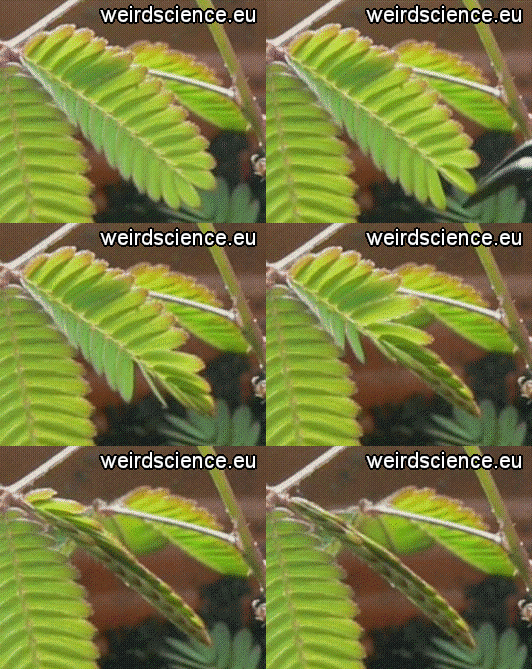
In the case of the sensitive plant, the most fascinating feature is its leaves, which are capable of nastic movements. The plant responds clearly to touch, something that is easy to observe. A gentle touch to a leaf, preferably near its apical region, is enough to trigger a visible reaction (Photo 8A). The secondary leaflets then fold upward and touch each other along their upper surfaces (Photos 8B–E). With stronger stimulation, entire sections of the compound leaf move closer together, and the petiole droops. After the stimulus ceases, the leaves gradually return to their original position, which usually takes about 15–20 minutes (Photo 8F). The speed of the reaction depends on the surrounding temperature, and at lower temperatures the response is noticeably slower.

B – 1 s, C – 2 s, D – 3 s, E – 6 s, F – 30 min
The observed changes are caused by variations in turgor pressure within specific groups of flexor and extensor cells. The flexor cells are located on the upper side, and the extensor cells on the lower side of the so-called pulvini, which are specialized structures found at the bases of leaf petioles and leaflets [5].
Mechanical stimulation triggers an action potential in the sensory cells of the sensitive plant, manifested as a change in the electric potential across the cell membrane. This signal is conducted along the membranes over considerable distances, similar to the way nerve cells transmit impulses in animals. The transmission speed can reach nearly 20 cm per second. The propagation of the action potential is associated with transmembrane ion movement, which in turn initiates subsequent processes. In the case of turgor changes in the motor cells of the pulvini, the key factor is the movement of potassium cations (K+). On the lower side of the pulvini, these ions are actively transported out of the cells following stimulation, which also causes water to flow out of the protoplasts. The turgor pressure in these cells decreases, resulting in the observed bending of the petioles. Returning to the resting state requires the reabsorption of potassium ions and water by the cells [5] [6].
Thanks to the rapid conduction of the action potential, the closing of the entire leaf occurs very quickly, taking only a few seconds.
What is the purpose of nastic movements? In the case of carnivorous plants, the answer seems obvious, but for the sensitive plant it is much more difficult to say. It is possible that leaf folding in response to touch serves as a defense mechanism against herbivores.
As we can see, the sensitive plant is a truly fascinating species that provides an excellent opportunity to explore the remarkable phenomenon of plant movement. Its ease of cultivation makes it suitable for teaching biology at all levels of education. The sight of a plant moving its leaves never fails to surprise observers, and this reaction can be skillfully used to spark curiosity, which may eventually lead to genuine understanding.
References:
- [1] Kunicki-Goldfinger W., Życie bakterii, Wydawnictwo Naukowe PWN, Warszawa, 2005, str. 206-213 back
- [2] Brahic C., Solar-powered sea slug harnesses stolen plant genes, New Scientist, 24.11.2008 back
- [3] Schumacher W., Fizjologia, w: Strasburger E., Botanika: podręcznik dla szkół wyższych, Powszechne Wydawnictwo Rolnicze i Leśne, Warszawa, 1967 back
- [4] Barneby R. C., Sensitivae censitae: a description of the genus Mimosa Linnaeus (Mimosaceae) in the New World, Memoirs of the New York Botanical Garden, 65, str. 624, back
- [5] Allen R. D., Mechanism of the Seismonastic Reaction in Mimosa pudica, Plant Physiology, 44, 1969, str. 1101-1107 back
- [6] Weintraub M., Leaf movements in Mimosa pudica L., New Phytologist, Vol. 50, No. 3, 1952, str. 357-382 back
All photographs and illustrations were created by the author.
Addendum
The mimosa’s seismonastic movements look especially striking on video:
Marek Ples